For hospitals, laboratories, and home-care providers, power quality is not a minor purchasing detail. A dependable Medical AC Adapter supports patient-monitoring equipment, infusion systems, diagnostic tools, and other devices that operate under demanding conditions. Global buyers must consider electrical performance, connector compatibility, documentation, and after-sales support together.
This guide introduces ten Medical AC Adapter options selected for practical purchasing decisions. The review considers output stability, energy efficiency, insulation, leakage-current control, thermal behavior, and resistance to daily handling. It also examines input ranges, regional plug systems, cable length, and replacement availability. Compliance claims should be checked against current product documentation, including relevant IEC 60601-1 and electromagnetic-compatibility requirements. A familiar certification logo is not enough. Buyers should request test reports, declarations, and traceable manufacturer information.
Small details matter.
An adapter may fit physically but deliver unsuitable voltage or polarity. That mistake can damage equipment or interrupt care. Supplier responsiveness matters too, especially when hospitals need consistent batches across several countries. No ranking can suit every device, clinical setting, or procurement budget. That limitation deserves attention. Some models may perform well in controlled environments but require further validation in humid wards, mobile clinics, or high-temperature regions. This article therefore treats the “top ten” as a practical starting point, not a universal verdict. Careful buyers should confirm device specifications, local import requirements, warranty terms, and service capacity before placing an order. Safety should remain the deciding factor.
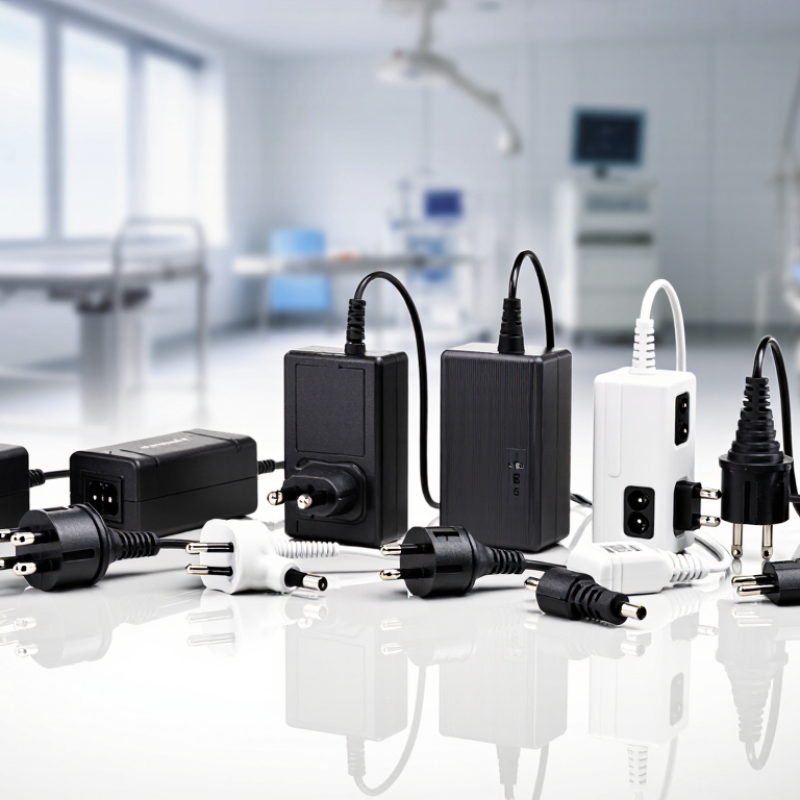
For global buyers, a medical AC adapter is more than a plug-in power source. It must deliver stable voltage, controlled leakage current, and dependable isolation. A credible top-10 comparison should examine output accuracy, efficiency, temperature limits, and service life. Fortune Business Insights estimated the global medical devices market at USD 512.29 billion in 2023. That expansion increases demand for safer power components.
IEC 60601-1 remains the core safety reference for medical electrical equipment. Buyers should also review IEC 60601-1-2 for electromagnetic compatibility and IEC 60601-1-11 for home healthcare environments. Risk analysis under ISO 14971 can reveal problems that a basic datasheet misses. Regional approval requirements also differ. North American, European, and Asian markets may require separate documentation, plugs, labeling, or testing evidence. Compliance is not automatically global.
Look closely at the details. A bedside monitor may need a low-noise adapter with reinforced insulation and two patient-protection measures. A portable pump may need wide-input operation, compact housing, and protection against short circuits. Check creepage distances, earth leakage, standby power, and performance at 40°C. Do not trust efficiency claims alone. A certificate can still leave integration risks unresolved. I would request test reports, traceability records, and samples under real load conditions. Small oversights matter. The best choice depends on the device, destination, clinical setting, and maintenance plan.
Medical-grade AC adapters need more than stable voltage. IEC 60601-1 evaluates electric shock, leakage current, insulation, and abnormal operation. IEC 60601-1-2 examines electromagnetic compatibility, including emissions and immunity. A quiet adapter is not automatically a safe adapter.
The IEC 60601-1-11 collateral standard matters for equipment used in homes. Household outlets can be unstable, crowded, and poorly grounded. For international sourcing, buyers should request evidence from the CB Scheme, plus regional approvals such as EN 60601-1 or UL 60601-1. CE and UKCA are conformity marks, not standalone safety certifications. That distinction is often missed.
Check the test report, not only the certificate.
The FDA Recognized Consensus Standards database lists IEC 60601-1 and IEC 60601-1-2 as relevant medical-device standards. The 2024 MarketsandMarkets medical power supply report forecasts market growth of roughly 7% annually, increasing pressure on suppliers and testing laboratories. More products do not mean better compliance. It can mean rushed documentation.
Review input range, earth leakage, creepage distance, isolation voltage, and temperature rise. Ask whether testing covered the final adapter, cable, and intended medical device together. ISO 14971 risk-management records can also reveal overlooked hazards, although ISO 14971 is not an adapter safety certificate. A certificate can still age. Verify its scope, revision, model number, and laboratory accreditation before approving global shipments.
The top ten medical AC adapters should be compared by performance and compatibility, not appearance alone. High-performing models usually offer stable voltage, low leakage current, overload protection, and quiet operation.
Common profiles include 5V, 9V, 12V, 15V, 18V, 24V, 36V, USB-C PD, dual-output, and hospital-grade designs. A 12V adapter may suit a monitor, while a 24V model may support a pump or diagnostic device. Output tolerance matters. Even a small voltage error can affect sensitive equipment.
Compatibility requires more than matching the plug. Buyers should check polarity, connector size, rated current, input range, insulation, and required medical certifications. Adapters designed for global use often accept 100–240V input and 50–60Hz frequency.
Certification documents should be verified through reliable suppliers, not copied product pages. In practice, heat buildup remains an overlooked issue. A compact adapter can perform well on paper but become uncomfortable after several hours.
Tips: Test the adapter with the actual device before deployment. Check the label twice. Leave current capacity above the device’s normal demand, but avoid incompatible overvoltage. Keep a record of test results, cable length, ambient temperature, and cleaning procedures. This process feels slow, yet it can reveal connector looseness or unstable output. I would not trust a perfect specification sheet without hands-on testing.
Top 10 Medical AC Adapters for Global Buyers
How to Select the Right Adapter for Different Medical Devices
Selecting a medical AC adapter begins with the device label, not the connector. Match the required output voltage exactly, then confirm current capacity. An adapter rated above the device’s current demand is usually safer than one operating at its limit. Check the label. Fit is not enough.
WHO’s Global Atlas of Medical Devices reports more than two million medical device types worldwide. Their electrical needs vary sharply, from portable monitors to powered therapy equipment. For patient-connected devices, review IEC 60601-1 requirements, including insulation, leakage current, and protection against electric shock. IEC 60601-1-2 also addresses electromagnetic compatibility, which matters near imaging systems and infusion equipment. A quiet adapter can still create interference. That is easy to miss.
Global buyers should verify input ranges, plug configurations, grounding, efficiency, and local certification requirements. The U.S. Department of Energy’s Level VI efficiency rules show why no-load power and standby losses deserve attention. For hospital environments, reinforced insulation and two means of patient protection may be necessary, depending on the device’s classification. Ask for test reports, not only a conformity logo. A common mistake is choosing by wattage alone. Thermal performance, cable flexibility, strain relief, and cleaning resistance also affect reliability. Requirements differ. Recheck them before purchase.
Typical adapter output profiles by medical device class
The chart compares representative nominal output power calculated from commonly used voltage and current profiles. Global buyers should confirm the device nameplate, connector polarity, leakage-current limits, medical electrical safety requirements, plug type, and regional approvals before selecting an AC adapter.
For global buyers, an AC adapter is a clinical reliability component, not a generic accessory.
The IEA’s Electricity 2024 report recorded 2.2% global electricity-demand growth in 2023 and expects stronger growth through 2026. This reinforces the need for stable input design. Specify 100–240 V AC, 50/60 Hz operation, correct output tolerance, low leakage current, and protection against surges. Regional plugs also matter: Type A, C, G, and I formats differ in grounding and certification. Details matter.
Supply planning deserves equal attention.
The World Bank and WHO’s Tracking SDG 7 report estimated that 685 million people lacked electricity access in 2022. Some facilities therefore depend on unstable grids, generators, or limited backup systems. Buyers should request thermal tests, load-cycle data, failure-rate evidence, and documented production capacity. Dual sourcing can reduce disruption, although it may complicate electrical validation. Not always simple.
Compliance evidence should match the destination market and medical application.
IEC 60601-1 addresses basic safety and essential performance, while IEC 60601-1-2 covers electromagnetic compatibility. A supplier should provide current test reports, declarations, traceability records, and plug-specific approvals. RoHS and REACH documentation may also be required for certain markets. Reported laboratory results are more useful than marketing claims. I would still verify every certificate directly, because outdated files remain an easy purchasing mistake.
Read the device label first. Match output voltage exactly, then confirm sufficient current capacity. Connector fit alone is not enough.
An adapter with extra current capacity avoids continuous operation near its limit. It may run cooler and support longer service life. Check actual device requirements carefully.
Review insulation, leakage current, creepage distance, and protection against electric shock. Some equipment needs two independent patient-protection measures. The exact requirement depends on classification.
An adapter can produce interference near imaging or infusion equipment. Request evidence for emissions and immunity testing. Quiet electrical behavior matters.
Many global applications require 100–240 V AC and 50/60 Hz operation. Confirm regional plugs, grounding, and local approval documents. Requirements differ.
Request current safety and electromagnetic compatibility reports, declarations, traceability records, and plug-specific approvals. Verify document dates and testing scope. Do not rely on a logo alone.
Examine surge protection, thermal performance, load-cycle data, and generator compatibility. Ask for testing under fluctuating input conditions. Backup planning is not always simple.
Check cable flexibility, strain relief, housing temperature, cleaning resistance, and short-circuit protection. Test samples under real loads. Small oversights matter.
Choosing the right Medical Ac Adapter is essential for ensuring the safe, stable, and efficient operation of healthcare equipment in different markets. This article explains the purpose of medical-grade AC adapters, including their role in delivering reliable power while supporting electrical safety, patient protection, and long-term device performance. It also reviews important safety certifications and compliance requirements that help buyers evaluate insulation, leakage current, electromagnetic compatibility, and overall product reliability.
The guide compares ten Medical Ac Adapter options according to output performance, connector compatibility, protection features, efficiency, and suitability for various medical devices. It further explains how to match voltage, current, polarity, and plug configuration with equipment specifications. For global purchasing, readers will learn how to consider regional voltage systems, plug standards, supply continuity, documentation, customs requirements, and local compliance. These factors can help hospitals, distributors, and equipment manufacturers make informed purchasing decisions while reducing compatibility risks and supporting dependable medical operations.

Tech Adapter