International travel is no longer a niche activity for business executives or holiday specialists. UN Tourism reported approximately 1.4 billion international tourist arrivals in 2024, returning to nearly pre-pandemic levels. WTTC’s 2024 Economic Impact Research also estimated that travel and tourism generated $11.1 trillion globally. These figures reveal a practical problem: millions of travelers carry electronic devices across countries with different socket designs and electrical systems.
A Universal Travel Adapter helps connect phones, laptops, cameras, and medical devices to local wall outlets. Picture a traveler arriving late in Tokyo, finding a Type A socket, and seeing a phone battery at 8 percent. The right adapter can prevent a small inconvenience from becoming a serious travel disruption. However, an adapter does not automatically convert voltage or frequency. Buyers must check device labels, especially when using hair dryers, shavers, or other high-power equipment.
The International Air Transport Association reported strong global passenger demand in 2024, with total traffic reaching record levels. More movement means more varied charging needs. It also makes product quality harder to ignore. A reliable adapter should provide secure contact, clear country compatibility, suitable power ratings, and recognized safety testing. USB-C charging is useful, but it does not replace careful voltage checks.
The decision still deserves reflection. Some buyers choose the cheapest model, then discover loose sockets or limited USB output. That choice may save money briefly. It may also create frustration in a crowded airport lounge. For global buyers, the best Universal Travel Adapter is not simply the most compact option. It is the one that matches real devices, travel destinations, and verified safety expectations.
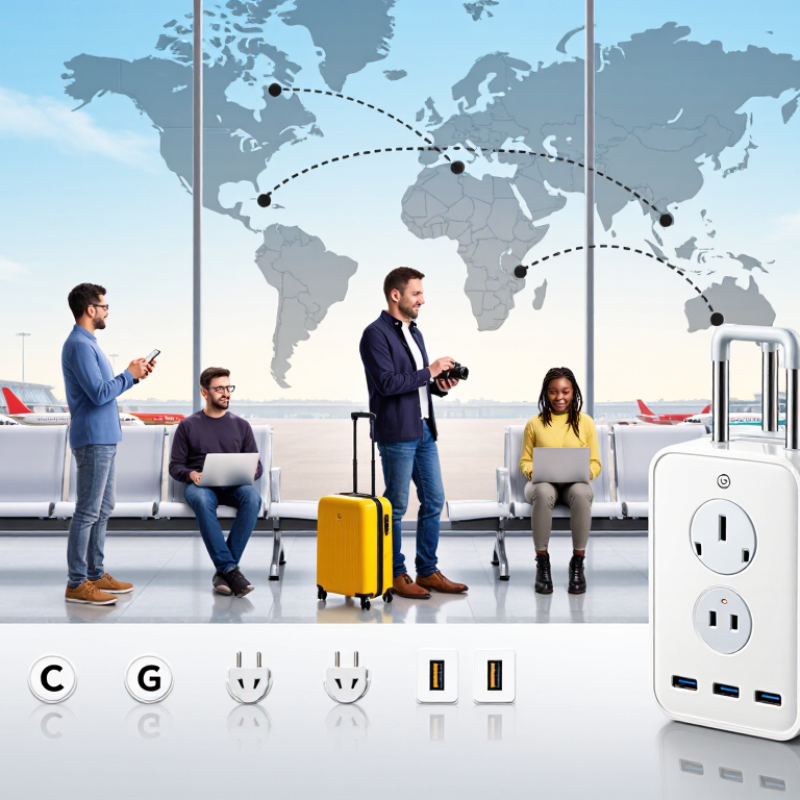
Why Universal Travel Adapters Matter for Global Buyers?
What Is a Universal Travel Adapter?
A universal travel adapter is a compact device that connects plugs to different wall sockets. It does not create electricity or automatically change voltage. Instead, it matches common plug shapes used across countries. A traveler may use one adapter in a hotel room, airport lounge, or rented apartment. Sliding pins or interchangeable sections often support several socket standards. The exact design depends on the product.
In practical use, check the destination socket before packing. A flat two-pin plug may fit one outlet, while a grounded three-pin plug may need another setting. Look for clear markings, firm contacts, safety shutters, and suitable electrical ratings. A loose adapter can become warm during use. That detail is easy to overlook. High-power appliances, such as hair dryers, may exceed an adapter’s limits. An adapter alone cannot solve that problem.
Reliable models usually state supported plug types and maximum load limits. They should also fit securely without forcing the wall socket. Some include USB charging ports, which can reduce cable clutter on a small desk. However, more features can mean more weight and more points of failure. I have found that compact designs are convenient, but tiny switches can be difficult to inspect. Buyers should compare the adapter’s rating with each device, especially older chargers and grounded equipment. Safety instructions still matter, even during a short trip.
| Data Dimension | What It Means | Common Global Information | Why It Matters to Buyers |
|---|---|---|---|
| Basic Definition | A compact device that allows a plug from one country to connect to a wall socket used in another country. | It changes the plug shape and socket interface, not the electrical voltage. | Travelers can use compatible chargers and appliances without carrying several country-specific plug adapters. |
| Plug Type A | Two flat parallel pins; some versions include a grounding pin. | Common in the United States, Canada, Mexico, Japan, and several other regions. | A universal adapter should provide a secure connection for Type A sockets and plugs where required. |
| Plug Type B | Two flat parallel pins plus a round grounding pin. | Widely used in North America and some nearby markets. | Grounded equipment may require a properly grounded adapter rather than a two-pin-only design. |
| Plug Type C | Two round pins, generally ungrounded. | Common across much of continental Europe, the Middle East, Africa, and parts of Asia. | It is widely supported, but buyers should check whether the destination socket accepts the exact plug size and spacing. |
| Plug Types E and F | Two round pins with different grounding arrangements. | Frequently used in European countries and neighboring regions. | Grounding compatibility is important for higher-power or metal-bodied appliances. |
| Plug Type G | Three rectangular pins arranged in a triangular pattern. | Used in the United Kingdom, Ireland, Malta, Cyprus, Singapore, and several other locations. | A compatible adapter should fit securely and preserve access to the socket's safety shutter system where applicable. |
| Plug Type I | Two angled flat pins, with an optional grounding pin. | Common in Australia, New Zealand, China, and Argentina. | Buyers should confirm the adapter supports both the angled-pin arrangement and the local grounding configuration. |
| Typical Mains Voltage | The electrical potential supplied by the destination socket. | Most countries use approximately 220–240 V; many countries in North America and parts of Asia use approximately 100–127 V. | The appliance or charger must support the destination voltage. A plug adapter alone does not convert voltage. |
| Frequency | The alternating-current cycle rate supplied by the electrical grid. | The most common values are 50 Hz and 60 Hz; some countries use both depending on the region or system. | Most phone and laptop chargers support both frequencies, but motorized or timing-sensitive appliances require closer checking. |
| Voltage Conversion | A separate transformer or converter changes voltage between electrical systems. | Most universal travel adapters only provide plug conversion; some products combine an adapter with a converter. | Selecting the wrong product can damage equipment or create a safety hazard. |
| USB Charging | Built-in USB ports allow compatible devices to charge without using a separate wall charger. | Common port formats include USB-A and USB-C; charging speed varies by output power and charging protocol. | Multiple ports can reduce luggage and support phones, tablets, cameras, and other low-power devices. |
| Grounding and Safety | Grounding helps reduce electric-shock risk for equipment designed to use an earth connection. | Protection features may include shutters, overload protection, fuses, insulated pins, and temperature control. | Safety features are especially important when powering higher-wattage devices or using crowded hotel sockets. |
| Power Rating | The maximum electrical load the adapter is designed to handle. | The rating is normally stated in watts, amperes, or both; exact limits differ by product design. | The adapter must be suitable for the connected appliance, especially for hair dryers, irons, kettles, and heaters. |
| Best-Suited Devices | Devices with an internal power supply or a broad input-voltage range. | Many modern phone, tablet, camera, and laptop chargers are marked “100–240 V, 50/60 Hz.” | Checking the charger label helps buyers determine whether only a plug adapter is needed. |
| Main Buyer Benefits | One travel accessory can support multiple destinations and devices. | It can reduce packing space, simplify international travel, and provide convenient multi-device charging. | Global buyers should prioritize destination compatibility, safety design, power rating, and charging capability over appearance alone. |
Countries use different plug shapes, voltages, and frequencies. Common supply levels are near 120 or 230 volts. Frequency often ranges between 50 and 60 hertz.
No. It changes plug compatibility only. It does not automatically convert voltage or frequency.
Look for “100–240V, 50/60Hz.” This range usually supports wider travel use. A single-voltage device may need a suitable converter.
Hair dryers, kettles, and heaters often use high power. Check converter capacity carefully. A small adapter may overheat under heavy demand.
Look for overload protection, internal fuses, and heat-resistant housing. Grounding support helps protect metal-cased devices. Safety shutters can reduce accidental contact.
Check for cracks, bent pins, loose sockets, or a burnt smell. Stop using damaged equipment. A loose connection beside a hotel lamp is not reliable.
Check the stated output, such as 5V, 9V, or 20V. USB-C power delivery should include overcurrent and overtemperature controls.
It may not. Avoid connecting several high-power appliances to one compact unit. I might overlook heat while focusing on plug shape. That deserves another check.
A Universal Travel Adapter is a practical device designed to help travelers connect their electronic equipment to wall outlets in different countries. Since electrical standards vary worldwide—including plug shapes, socket designs, voltage levels, and frequency—a suitable adapter can improve compatibility and reduce the need to carry multiple plug converters. However, an adapter changes the plug connection, not necessarily the voltage, so travelers should confirm that their devices support the destination’s electrical system.
For global buyers, safety and convenience are equally important. Useful features may include built-in surge protection, overload protection, secure socket coverage, durable materials, and clear compatibility information. When choosing a Universal Travel Adapter, consider the countries you plan to visit, the types and number of devices you will use, supported voltage ranges, portability, and ease of operation. Selecting a reliable model with appropriate safety certifications can help provide a more convenient and responsible charging experience during international travel.

 Tech Adapter