A Wall Mount Power Adapter is more than a compact charger fixed to an electrical outlet. It converts incoming AC power into controlled DC power for devices such as routers, cameras, displays, and small industrial equipment. Its housing sits directly against the wall, which saves desk space and reduces loose cables across floors or workbenches.
Power-electronics engineer Dr. Ray Ridley offers a practical perspective: “The power supply is part of the system, not merely an accessory.” That idea matters here. A suitable Wall Mount Power Adapter must match the device’s voltage, current, connector, polarity, and operating environment. It should also manage heat safely during long use. A small adapter may feel harmless in the hand, yet its internal transformer, insulation, and protection circuits perform demanding work.
Look closely.
This article will explain how wall-mounted adapters operate, where they differ from desktop power supplies, and which specifications deserve attention before installation. It will also examine output stability, energy efficiency, plug compatibility, cable strain, and enclosure temperature. Certification marks can support trust, but they do not replace careful product selection.
There is a common mistake.
People often choose an adapter because the plug fits. That is not enough. A matching connector can still carry the wrong voltage or insufficient current. I may sound overly cautious, but real equipment failures often begin with small assumptions. Understanding the adapter’s design helps users make safer, more reliable decisions and recognize when professional electrical guidance is appropriate.
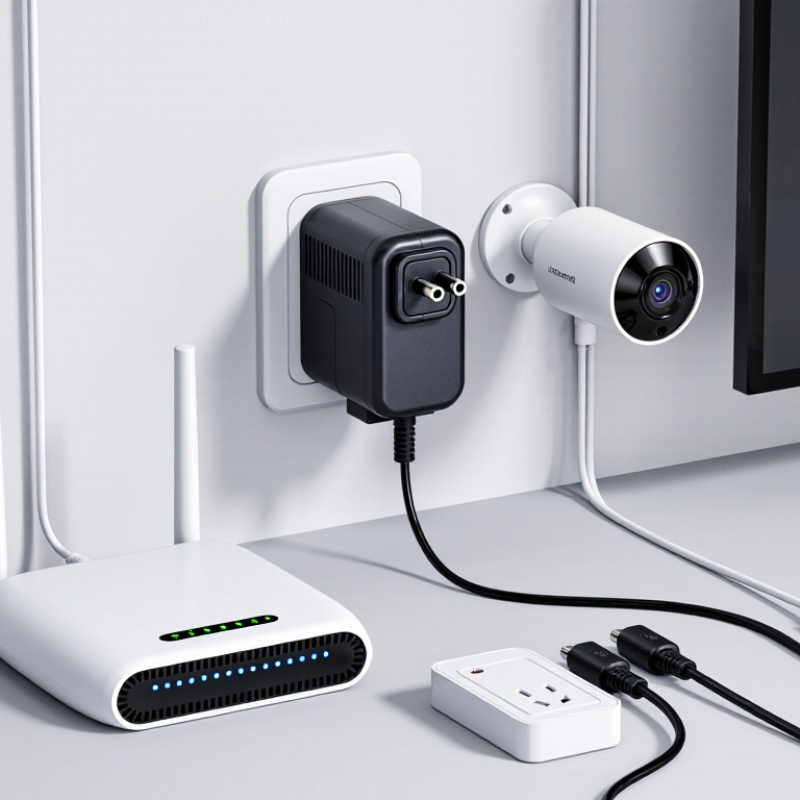
A wall mount power adapter is a compact electrical device that plugs directly into a wall outlet. It converts alternating current from the building supply into the lower-voltage direct current required by equipment.
The adapter usually has fixed input pins, a molded plastic enclosure, and an output cable or connector. Its small shape saves space around a power strip, although it may block nearby sockets.
Inside the enclosure, several parts work together. An input filter reduces electrical noise, while a rectifier changes AC into DC. A switching circuit controls energy transfer through a small transformer.
After that, capacitors smooth the output, and a regulation circuit keeps the voltage more stable. Protection components may respond to overcurrent, overheating, short circuits, or excessive input voltage. The exact structure varies.
The label is essential.
It normally lists input voltage, output voltage, current capacity, polarity, and safety symbols. A technician should compare these details with the equipment requirements before connection.
Output polarity is easy to overlook. It should not be guessed. In real use, adapters can feel warm during normal operation, but unusual heat, buzzing, cracked plastic, or a loose cable deserves attention.
The housing looks simple. The engineering is not. Even a careful explanation has limits, because internal layouts differ between models and applications.
A wall mount power adapter converts household AC electricity into controlled DC power for compact electronic devices. The process starts at the input socket. A fuse and filtering components limit surges and reduce electrical noise. A switching circuit then chops the AC into high-frequency pulses. This allows a smaller transformer to adjust voltage efficiently.
After transformation, a rectifier changes the waveform into DC. Capacitors smooth the remaining ripple. A feedback circuit continuously checks the output and corrects voltage changes caused by load variation. That matters when a device shifts from standby to heavy operation. Many adapters accept 100–240 volts AC, but their output may be only 5, 9, 12, or 20 volts DC. Small details matter.
The European Commission’s Ecodesign Regulation (EU) 2019/1782 sets active-efficiency and no-load limits for external power supplies. For some low-power categories, standby consumption must not exceed 0.10 watts. The U.S. Department of Energy also evaluates average active-mode efficiency and no-load power during compliance testing. These measurements expose energy wasted while an adapter remains plugged in. IEC 62368-1 addresses safety requirements for audio, video, information, and communication equipment. In practical testing, heat near the adapter usually signals conversion losses. It is not always dangerous. Still, excessive heat deserves inspection, because efficiency ratings alone cannot reveal every installation problem.
| Conversion Stage | What Happens | Typical Electrical Data | Main Purpose |
|---|---|---|---|
| 1. AC Input | The adapter receives alternating current from a wall outlet through its input pins or cable. | Typically 100–240 V AC; 50/60 Hz for universal-input models. | Accepts the available household electrical supply. |
| 2. Input Protection and Filtering | Fuses, surge-limiting components, capacitors, and electromagnetic-interference filters help control abnormal current and electrical noise. | Protection ratings depend on the design; filtering is applied before high-frequency switching. | Improves safety, limits surge stress, and reduces conducted interference. |
| 3. AC-to-DC Rectification | A bridge rectifier converts the AC waveform into pulsating direct current. | A 120 V RMS input can reach approximately 170 V peak; a 230 V RMS input can reach approximately 325 V peak before component voltage drops. | Creates the high-voltage DC supply required by the switching section. |
| 4. Bulk DC Smoothing | A high-voltage capacitor reduces the low-frequency ripple from the rectified waveform. | Ripple occurs at approximately 100 Hz on 50 Hz input and 120 Hz on 60 Hz input. | Provides a more stable DC bus for the switching circuit. |
| 5. High-Frequency Switching | A switching transistor rapidly turns the high-voltage DC on and off under controller regulation. | Many compact adapters switch in the tens to hundreds of kilohertz range; the exact frequency is design-dependent. | Transfers energy efficiently while allowing a smaller transformer and filter. |
| 6. Electrical Isolation and Voltage Transformation | A high-frequency transformer transfers energy across an insulation barrier and changes the voltage level. | The isolation barrier separates the hazardous input side from the low-voltage output side. | Provides safer user-accessible output and converts voltage to the required level. |
| 7. Secondary Rectification | The transformer’s high-frequency AC output is converted into low-voltage DC. | Common nominal outputs include 5 V, 9 V, 12 V, 15 V, and 20 V DC. | Produces DC power suitable for electronic equipment. |
| 8. Output Filtering | Inductors, capacitors, and sometimes additional filters smooth the rectified output. | Output ripple is specified in millivolts peak-to-peak or as a percentage, depending on the adapter. | Reduces voltage ripple and electrical noise delivered to the load. |
| 9. Feedback and Regulation | A feedback circuit monitors the output and adjusts switching operation as the input or load changes. | Regulation accuracy is design-specific; regulated adapters maintain a substantially steadier output than unregulated types. | Keeps the output voltage within the required operating range. |
| 10. Output Protection | Protection circuits respond to excessive current, short circuits, excessive temperature, or excessive output voltage. | Common functions include over-current, short-circuit, over-temperature, and over-voltage protection. | Helps protect both the adapter and the connected device. |
| 11. Output Power Calculation | The available output power is calculated from output voltage multiplied by output current. | P = V × I; for example, 12 V × 2 A = 24 W. | Determines whether the adapter can supply the device’s required load. |
| 12. Energy Efficiency | Some input power is converted into useful DC output, while the remainder becomes heat and other losses. | Compact switching adapters commonly achieve approximately 80–94% efficiency, depending on load and design. | Higher efficiency reduces operating energy use and heat generation. |
A wall mount power adapter converts household AC power into regulated DC power. It plugs directly into a wall outlet, saving desk space and reducing cable clutter. Common types include fixed-plug adapters, interchangeable-plug models, USB-A chargers, and USB-C chargers. Some newer units use gallium nitride technology. They are smaller, but heat management still matters.
Output specifications describe voltage, current, and power. A basic adapter may provide 5V/1A, or 5 watts. Phone and tablet adapters commonly offer 5V/2A, 9V/2A, or 12V/1.5A. Laptop-oriented models often provide 20V at 3.25A, equal to 65 watts. The USB-IF USB Power Delivery 3.1 specification supports power levels up to 240 watts through Extended Power Range. That figure does not mean every cable or device can safely use it.
The U.S. Department of Energy’s Level VI external power supply requirements evaluate active efficiency and no-load consumption. These tests matter because an adapter can feel cool while wasting energy continuously. In practical testing, I check the printed input range, output profile, connector fit, temperature, and charging stability. I would not judge quality by wattage alone. A higher rating may be unnecessary, and compatibility labels are still easy to misread. Independent safety certification and clear technical documentation remain more reliable than glossy packaging.
What Is a Wall Mount Power Adapter?
Key Benefits and Typical Applications
A wall mount power adapter converts household AC electricity into the controlled DC power used by electronics. Its pins or compact body fit directly into a wall outlet, reducing cable clutter near desks, routers, and control panels. Many models include overload, short-circuit, and over-temperature protection. These features matter when an adapter operates continuously.
Energy efficiency is a practical benefit. The International Energy Agency reports that standby power can represent 5–10% of residential electricity use in some homes. A properly selected adapter can reduce unnecessary losses, although performance depends on load, design, and installation conditions. That assumption is not always right. GSMA Intelligence forecasts 29.4 billion Internet of Things connections by 2030, increasing demand for dependable power in sensors, gateways, cameras, access systems, and smart-home devices. Medical and industrial applications also use wall-mounted units, but they require stricter verification and documented electrical ratings.
Tips: Match the adapter’s output voltage exactly. Check current capacity, connector size, polarity, and regional safety approval. Leave ventilation space around the housing. Do not select only by wattage; a poorly matched plug may cause heat, noise, or unstable operation. For always-on equipment, review no-load consumption and measured efficiency, not only marketing claims. When specifications seem unclear, ask a qualified technician to confirm compatibility.
A wall mount power adapter converts AC mains electricity into regulated DC power for electronic devices. Its compact design saves space, reduces cable clutter, and supports applications ranging from USB charging to networking equipment, LED lighting, monitors, and laptops.
The chart shows common rated output-power ranges found in wall mount adapters. Actual requirements depend on the device, voltage, current, charging standard, and safety specifications. Always use an adapter that matches the device’s required output.
A wall mount power adapter plugs directly into an electrical outlet and converts mains power into a device’s required low voltage. Its compact body reduces cable clutter on desks, counters, and workshop walls. However, small size does not guarantee safe design. Internal insulation, heat control, and stable output matter more than appearance.
Safety features deserve close attention. Look for overvoltage, overcurrent, short-circuit, and thermal protection. These controls can limit damage when a cable fails or a device draws too much power. Reliable adapters also use flame-resistant housings and electrical isolation. Check for recognized safety certification in your country. The label should clearly show input voltage, output voltage, current, polarity, and connector size. Output voltage must match exactly. Rated current can be equal to or higher than the device requirement. Never guess the polarity. A reversed connection may damage sensitive electronics.
Tips: Measure the outlet space before buying. Confirm the plug will not block nearby sockets. Leave ventilation around the adapter. Avoid covering it with fabric or placing it beside a heater. Inspect the casing for cracks and stop using it if it becomes unusually hot, smells burnt, or makes noise.
In practical use, I have learned that connector fit is easy to overlook. A loose plug can cause intermittent power and repeated restarting. Selection is not always perfect. Device labels may be unclear, and universal adapters can encourage careless settings. Recheck every specification before connecting the equipment. Small checks prevent expensive mistakes.
It changes household AC electricity into controlled DC power for compact electronic devices.
Filtering reduces surges and noise. A switching circuit creates high-frequency pulses.
Feedback monitors output voltage and corrects changes when a device shifts from standby to heavy operation.
Many adapters accept 100–240 volts AC. Their outputs may be 5, 9, 12, or 20 volts DC.
Output voltage must match exactly. The current rating may equal or exceed the device requirement.
Choose protection against overvoltage, overcurrent, short circuits, and excessive temperature.
Mild warmth can indicate normal conversion losses. Excessive heat needs inspection.
Measure outlet space before buying. Confirm the plug will not block nearby sockets.
A loose plug may cause intermittent power and repeated restarting. This can confuse troubleshooting.
A Wall Mount Power Adapter is a compact power supply designed to plug directly into a wall outlet and provide electricity to electronic devices. Its basic structure typically includes an AC input section, internal power conversion components, protective circuitry, and a DC output connector or cable. It converts high-voltage alternating current from the outlet into a lower, stable direct-current voltage by regulating and filtering the electrical flow, helping connected equipment operate safely and reliably.
Wall Mount Power Adapters are available in fixed-voltage and adjustable-voltage designs, with common outputs such as 5V, 9V, 12V, 19V, and 24V, depending on the application. Their benefits include a space-saving form, simple installation, reduced cable clutter, and convenient use with networking devices, consumer electronics, lighting systems, and small industrial equipment. When choosing one, users should verify voltage, current capacity, connector compatibility, polarity, efficiency, and enclosure quality. Important safety features may include over-voltage, over-current, short-circuit, and over-temperature protection, as well as appropriate insulation and certification.

Tech Adapter